Pros and Cons of Living in Stadium District Tacoma: What You Should Know Before Moving
If you're considering moving to Stadium District Tacoma, you're probably drawn to something that makes this neighborhood stand out. Maybe it's the historic architecture, the established residential streets, the restaurants and coffee shops, the proximity to Downtown Tacoma, or the opportunity to live in a condo or older home with a distinctive character. Stadium offers a combination of urban convenience and historic surroundings that can be difficult to find in newer residential developments. However, the same characteristics that make the neighborhood appealing can also create practical considerations involving parking, property maintenance, hills, housing density, and ongoing ownership costs.
As Shu, a Realtor in Tacoma and throughout Western Washington, I believe understanding those tradeoffs is one of the most important parts of choosing where to live. A neighborhood should fit your priorities, budget, property preferences, and everyday routine rather than simply looking attractive in photographs. Stadium District has a great deal to offer, but it isn't automatically the right choice for every buyer. This guide explores the advantages and disadvantages of living in Stadium District Tacoma so you can make a more informed decision about whether this part of North Tacoma belongs on your home search list.
What Are the Pros and Cons of Living in Stadium District Tacoma?
The biggest advantages of living in Stadium District Tacoma include its historic architecture, neighborhood businesses, walkability, proximity to Downtown Tacoma, access to Wright Park, and variety of housing options. The primary tradeoffs include older-home maintenance, condominium association responsibilities, variable parking arrangements, hills, urban density, and substantial differences between individual properties. Stadium can be a compelling option if you appreciate an established urban neighborhood, but choosing the right home requires understanding both the property and the surrounding location.
What makes Stadium particularly interesting is that many of its advantages and disadvantages come from the same characteristics. Historic buildings provide architectural distinction but may require more investigation into their condition. A concentrated business district creates convenience but also brings activity and traffic to nearby streets. Elevated terrain can provide attractive views while making some walking routes and driveways more challenging. Understanding these relationships will help you evaluate Stadium based on how you actually want to live.
Pro #1: Stadium District Has Historic Architecture and a Distinctive Neighborhood Identity
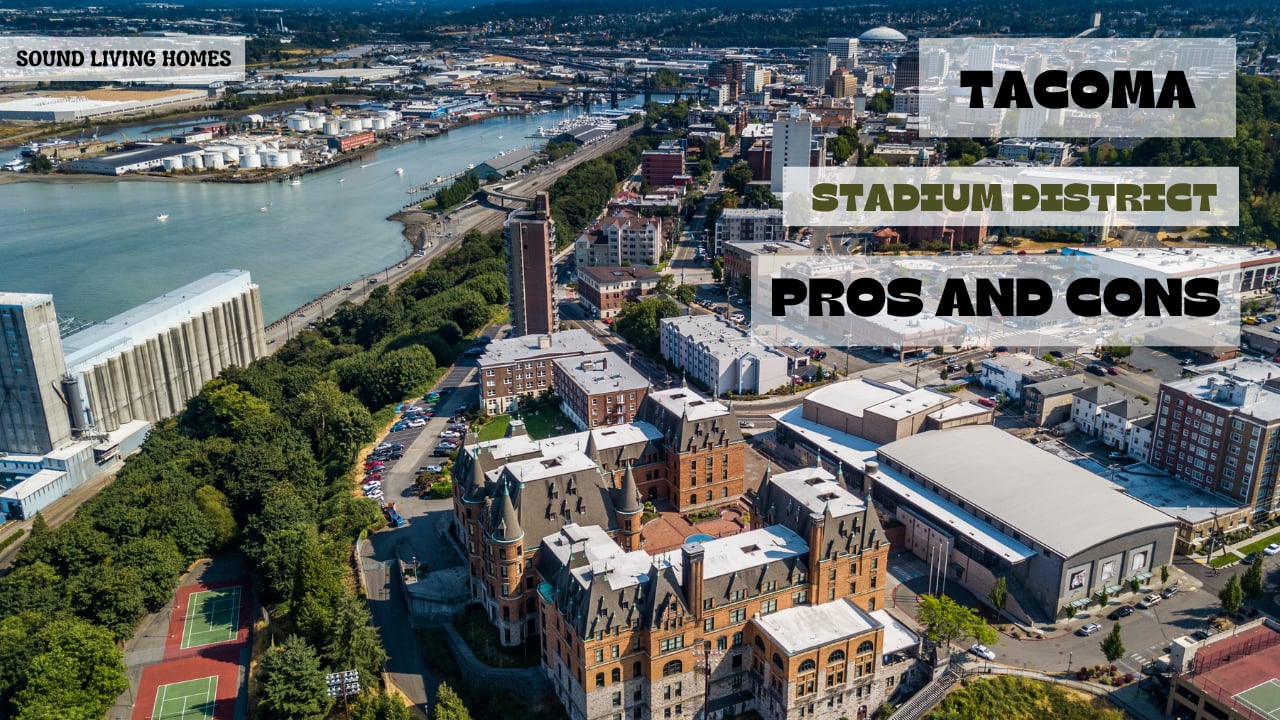
One of Stadium District's strongest characteristics is its architectural history. The Stadium-Seminary Historic District contains significant examples of residential architecture dating from Tacoma's early development, including homes built during the late 19th and early 20th centuries. Tree-lined streets, substantial historic residences, established landscaping, and buildings from different eras create a streetscape that looks noticeably different from newer neighborhoods. Stadium High School and Stadium Bowl also contribute to the area's recognizable identity, with architecture and topography that have become enduring parts of Tacoma's visual landscape.
For buyers interested in older homes, this history can translate into architectural features that are less common in modern construction. Depending on the property, you may encounter original woodwork, hardwood floors, built-ins, distinctive windows, covered porches, detailed trim, unusual floor plans, or other elements reflecting earlier construction styles. These characteristics can give individual properties a strong sense of identity, although their condition and preservation vary considerably. If historic character is important to you, Stadium offers an opportunity to explore homes where architecture itself may be a significant part of the ownership experience.
Pro #2: Restaurants, Coffee Shops, and Everyday Services Are Part of the Neighborhood
Stadium is more than a collection of residential streets because it has an established neighborhood business district. Restaurants, coffee shops, grocery shopping, professional services, and other businesses are concentrated around its commercial streets, creating opportunities to combine everyday errands with neighborhood activities. Stadium Thriftway is one of the longstanding businesses associated with the district, while the surrounding commercial area provides additional dining and service options. This mixture of residential and commercial uses is an important reason Stadium feels different from communities where most errands require traveling to a separate shopping center.
The practical benefit depends on where you live and which businesses you regularly use. A property near the commercial core may make certain errands relatively convenient on foot, while a home farther into the residential streets may provide a different experience. The neighborhood's hills also affect walking routes, so distance alone doesn't tell the complete story. If nearby restaurants, coffee, and everyday services are important to you, spend time walking from a property you're considering to the destinations you would actually visit.
Pro #3: Wright Park Adds a Significant Outdoor Space to an Urban Setting
Wright Park is one of the major advantages of Stadium's location because it provides a substantial public green space alongside the neighborhood's urban environment. The park features mature trees, open areas, walking paths, recreational spaces, and the W.W. Seymour Botanical Conservatory. Its presence creates a noticeable contrast with nearby commercial streets, historic buildings, and downtown activity. For someone who enjoys walking, spending time outdoors, or having a large established park nearby, Wright Park can become a meaningful part of the surrounding neighborhood experience.
The combination of urban amenities and accessible green space is worth evaluating when comparing Stadium with other Tacoma neighborhoods. You can experience a commercial district, historic residential streets, and a major city park within a relatively compact part of Tacoma. However, proximity varies by property, and a home directly alongside the park may offer a different experience from one several blocks away. If Wright Park is one of your main reasons for considering Stadium, explore the routes and surroundings of the individual properties on your shortlist.
Pro #4: Stadium District Is Close to Downtown Tacoma and Other North End Destinations
Location is another important advantage of living in Stadium District Tacoma. The neighborhood sits immediately north of Downtown Tacoma, with access to Old Town, the waterfront, North Slope, Proctor, and other parts of central and North Tacoma. Depending on your destination and transportation preferences, that location can make restaurants, museums, entertainment, employment centers, waterfront areas, and additional neighborhood business districts relatively accessible. Stadium has its own identity, but residents can also take advantage of the broader collection of destinations located around central Tacoma.
That connectivity is particularly useful to understand if you're relocating from another part of Western Washington. Stadium offers a different geographic experience from communities such as Fircrest, University Place, Lakewood, Gig Harbor, Puyallup, or Spanaway, where residential and commercial areas may be arranged differently. Being close to downtown does not automatically mean every destination will be convenient for every person, especially when traffic, parking, hills, and transportation choices are considered. Still, Stadium's central location is one of its defining features and deserves serious consideration when comparing neighborhoods.
Pro #5: You Can Choose Between Different Housing and Ownership Styles
Another advantage of Stadium District Tacoma real estate is the variety of available property types. The broader area includes historic detached homes, condominiums, apartments, and multifamily properties, with significant differences in size, layout, condition, parking, outdoor space, and maintenance responsibilities. Buyers considering Stadium may therefore have opportunities to compare several ownership experiences within the same general neighborhood. Someone interested in a historic detached home may be looking for architectural details and private outdoor space, while another buyer may prefer a condominium with shared exterior maintenance responsibilities.
This variety can make Stadium worth exploring even when you're uncertain about the type of property you want. Touring a few different options may help you clarify whether you prefer the control and responsibilities of a detached home or the shared ownership structure of a condo. The important distinction is that property type affects more than appearance or purchase price. It also influences insurance, maintenance, association obligations, parking, monthly expenses, and the decisions you'll make throughout ownership.
Con #1: Older Homes May Require More Maintenance and Investigation
Historic architecture is an attraction, but older properties deserve careful due diligence. A Stadium home may have undergone numerous renovations, repairs, additions, and system replacements over several decades, leaving different components at different stages of their useful lives. Electrical systems, plumbing, sewer lines, roofs, foundations, drainage, heating, windows, siding, and previous improvements may all warrant investigation depending on the property. A beautifully renovated interior does not necessarily indicate that every major system has been updated.
This does not mean older Stadium homes should automatically be considered problematic. Many have been maintained and improved extensively, while others may need more attention, and the difference is not always obvious from listing photographs. If you're considering a historic or older home, review available maintenance and improvement information, understand the inspection provisions of your purchase agreement, and investigate significant questions before making your final decision. The goal is to understand the property's actual condition and likely ownership responsibilities rather than relying on assumptions about its age.
Con #2: Condo Ownership Introduces HOA Costs and Shared Responsibilities
Condominiums can provide a compelling alternative to detached homes, but buying a Stadium condo means evaluating more than the individual unit. You also become part of a homeowners association responsible for managing shared property, finances, maintenance, insurance, and other obligations established by the governing documents. Monthly dues, reserve funding, building condition, anticipated projects, potential special assessments, parking arrangements, and association rules can all affect your experience as an owner. Two condos with similar purchase prices may therefore have substantially different ongoing costs and responsibilities.
It is important not to assume that lower HOA dues automatically mean a better financial arrangement. One association may collect more each month while setting aside funds for future projects, while another may have lower dues and significant maintenance needs approaching. The financial picture depends on the individual building, its condition, governing documents, budget, reserve information, and other circumstances. If you're comparing condos in Stadium District Tacoma, review the association information carefully and make sure you understand what you're purchasing beyond the interior of the unit.
Con #3: Parking Can Be Less Predictable Than in Newer Residential Developments
Parking is one of the most practical considerations when evaluating Stadium District. Because much of the neighborhood developed before modern expectations for attached garages and multiple-car households, parking arrangements vary considerably. Some detached homes have garages or driveways, certain condos include assigned or covered parking, and other properties rely more heavily on street parking. Even when a home has a garage, its dimensions and accessibility may differ from what you're accustomed to in newer construction.
This is worth investigating before making an offer, particularly if you own multiple vehicles, regularly have guests, or place a high value on dedicated parking. For a condominium, verify how spaces are assigned, whether they are legally associated with the unit, and what rules apply to their use. For a detached home, consider whether the garage or driveway accommodates your vehicle and how the surrounding street functions at different times. Parking may not be the most exciting part of a home search, but it can influence your daily routine long after the excitement of moving has passed.
Con #4: Hills and Sloped Properties Can Affect Everyday Living
Stadium's elevated location above Commencement Bay is part of what gives the neighborhood its distinctive setting, but the terrain creates practical considerations. Walking routes can involve noticeable elevation changes, and some properties have steep driveways, stairs, retaining walls, terraced landscaping, or sloped outdoor spaces. A destination that appears close on a map may feel farther away when the route involves a substantial hill. If walking to shops, parks, or downtown is one of your priorities, experiencing the route in person is more useful than relying exclusively on distance.
Topography can also influence property maintenance and usability. Depending on the lot, drainage, retaining structures, access, landscaping, and outdoor living areas may require additional consideration. A sloped yard can be attractive and functional, but it may not support the same activities as a level lot, and certain improvements may be more complicated. When you're considering a Stadium home, walk the entire property and think about how the terrain will affect your routine and any future projects you have in mind.
Con #5: Urban Convenience Comes With More Activity and Housing Density
Stadium's restaurants, services, apartments, condos, historic homes, and proximity to downtown create a more urban environment than many surrounding residential communities. That combination can be an advantage when you want destinations nearby, but it also means traffic patterns, parking demand, pedestrian activity, and commercial uses may be more noticeable on certain blocks. A home near the business district can feel quite different from a property several streets into a residential area. Even two listings described as being in Stadium District may offer different experiences because of their immediate surroundings.
The best way to evaluate this is to visit the specific block at more than one time of day when possible. Pay attention to traffic, parking, nearby uses, street activity, and how the surroundings feel relative to your preferences. Avoid assuming that a neighborhood's general reputation tells you everything about a particular address. Stadium's variety is one of its strengths, but that same variety makes property-level research especially important.
Con #6: Comparing Property Values Can Be More Complicated
Stadium's housing variety can make property valuation less straightforward than in neighborhoods with many similar homes. A historic detached house with a larger lot, a renovated residence with limited parking, and a condo with a water view may all be located within a relatively small geographic area while attracting different buyer interest. Age, condition, layout, views, association costs, parking, outdoor space, and renovation history can influence how buyers evaluate each property. A nearby sale is not automatically the best comparable simply because it is geographically close.
When buying a home or condo in Stadium District Tacoma, I prefer to examine relevant recent sales and current competition with careful attention to the differences between properties. The same principle applies if you already own a Stadium property and are thinking about selling. Pricing should reflect the individual property and the market conditions at the time, not a broad assumption that every home in the neighborhood should perform similarly. This is another reason working through the details before making a major decision can be worthwhile.
How Does Stadium District Compare With Other Tacoma Neighborhoods?
If you're considering Stadium, it can be useful to compare the neighborhood with North Slope, Proctor, Old Town, Downtown Tacoma, and other parts of the city. North Slope offers another setting with historic residential architecture, while Proctor has its own established commercial district and surrounding housing options. Old Town places you closer to the waterfront, and Downtown Tacoma offers a different mix of urban residential properties and destinations. The differences involve housing type, topography, property condition, parking, location, and everyday convenience rather than one neighborhood being universally better than another.
Your comparison may extend well beyond Tacoma as well. Fircrest, University Place, Lakewood, Gig Harbor, Puyallup, Spanaway, Renton, Kent, Steilacoom, Silverdale, and other communities throughout Pierce, King, Kitsap, and Thurston Counties offer different combinations of housing, lot configurations, commuting considerations, recreation, and local amenities. As Shu, a Realtor in Tacoma and across Western Washington, I can help you compare those practical differences without trying to steer you toward a particular community. Sometimes the most useful part of a home search is understanding which tradeoffs matter most to you before narrowing your options.
Frequently Asked Questions About Living in Stadium District Tacoma
Is Stadium District Tacoma walkable?
Stadium has a concentrated neighborhood business district with restaurants, coffee shops, grocery shopping, services, and other destinations, which can make walking a meaningful part of daily life. However, the experience varies by address because the neighborhood includes hills and different distances from its commercial center. If walkability is important to you, test the actual routes between a property and the places you expect to visit. That will give you a more useful understanding than a general neighborhood description.
Are homes in Stadium District Tacoma mostly historic?
Historic residential architecture is an important part of Stadium's identity, but the area also includes condominiums, apartments, multifamily buildings, and properties from different construction periods. Even among older homes, condition and renovation history can vary substantially. Some retain many original details, while others have undergone extensive improvements. Buyers should evaluate individual properties rather than assuming that every Stadium home offers the same characteristics.
Are there condos in Stadium District Tacoma?
Yes. Condominiums are a meaningful part of the Stadium housing market and provide an alternative to detached home ownership. When evaluating a condo, consider the individual unit along with the homeowners association, monthly dues, reserve information, insurance responsibilities, parking, rules, building maintenance, and potential assessments. These factors can influence the overall ownership experience and should be considered alongside location, layout, condition, and price.
Is parking a concern in Stadium District?
Parking arrangements vary significantly between properties and blocks, so it is worth investigating carefully. Some homes have garages or driveways, certain condos offer assigned spaces, and other properties depend more heavily on street parking. If dedicated parking is important to you, confirm what comes with the property and evaluate whether it meets your actual needs. Visiting the area at different times can also help you understand the surrounding parking conditions.
Is Stadium District close to Downtown Tacoma?
Yes. Stadium District sits immediately north of Downtown Tacoma and is connected to several other parts of central and North Tacoma. That location can provide access to restaurants, entertainment, employment centers, parks, waterfront destinations, and other urban amenities. The convenience of individual destinations will depend on the specific property, route, traffic conditions, and transportation preferences. The neighborhood's hills are also worth considering if you expect to walk regularly.
Is it better to buy a house or condo in Stadium District Tacoma?
Neither property type is automatically better because they offer different responsibilities and ownership experiences. A detached home generally gives you more direct control over the property while placing more maintenance responsibility on you, whereas a condo may shift some shared maintenance to an association while introducing dues and collective financial obligations. Compare total ownership costs, property condition, parking, location, association information where applicable, and your long-term plans. The right choice is the one that aligns with your priorities and financial expectations.
What should I know before moving to Stadium District Tacoma?
Start by understanding the neighborhood's mixture of historic homes, condos, businesses, parks, hills, and urban activity. Then evaluate the individual property, including condition, parking, maintenance responsibilities, location, and ongoing costs. Spend time walking or driving the routes you expect to use, and compare Stadium with other neighborhoods if you're still deciding. The more closely you connect the property and neighborhood to your actual routine, the better informed your decision will be.
So, Is Living in Stadium District Tacoma Worth Considering?
Stadium District offers a combination of historic architecture, established residential streets, neighborhood businesses, Wright Park, housing variety, and proximity to Downtown Tacoma that makes it distinctive within the South Sound. Those characteristics can be appealing if you're looking for an urban neighborhood with recognizable architecture and a mixture of property types. However, the same setting brings considerations involving older-home maintenance, condo associations, parking, hills, density, and differences between individual blocks and buildings. Understanding both sides is essential because the neighborhood's appeal does not eliminate the need to evaluate each property carefully.
My recommendation is to experience Stadium before making a decision. Walk the residential streets, explore the business district, visit Wright Park, look at several housing types, and pay attention to parking and topography. Compare what you find with your priorities and with other Tacoma or Western Washington communities you're considering. The objective is not to decide whether Stadium is universally good or bad, but whether its particular combination of benefits and tradeoffs makes sense for your next home.
Continue Exploring Stadium District Tacoma
If Stadium District is on your shortlist, the other articles in this neighborhood series can help you explore the details from different perspectives. The general neighborhood guide provides a broader look at the area's history, housing, businesses, parks, and location, while the buyer guide focuses more closely on inspections, older homes, condo association documents, parking, views, and purchase decisions. Reading them together can help you move from understanding the neighborhood to evaluating the individual properties available within it.
As this series continues, I'll also cover Stadium District restaurants, coffee shops, parks, local activities, and the considerations involved in selling a Stadium home or condo. Those topics will provide additional context whether you're moving into the neighborhood, comparing it with another part of Tacoma, or already own property here.
Explore Stadium District Tacoma Homes and Condos for Sale
Once you understand the pros and cons of living in Stadium District Tacoma, looking at current listings can help you see how those tradeoffs appear in actual properties. Compare historic detached homes with condos, renovated interiors with older original features, properties with dedicated parking against those with different arrangements, and locations near the business district with more residential blocks. You may discover that the property type and exact location matter as much as the neighborhood name itself.
If a particular home or condo catches your attention, I can help you look beyond the listing photographs and evaluate comparable sales, condition, parking, association information where applicable, and the practical questions that matter before you decide whether to pursue it. You don't have to have every answer before reaching out. Sometimes the best first step is simply identifying which questions deserve attention.
Selling Your Current Home Before Moving to Stadium District?
If buying in Stadium District is part of a larger move, it is worth planning the sale of your current home alongside your purchase. Understanding what your existing property may be worth, what selling costs could look like, and how much equity may be available can help you establish a realistic budget and timeline. This is especially important when your next purchase depends on proceeds from the current home or when you're trying to coordinate two transactions.
My Ultimate Guide to Selling a Home in Western Washington explains how to prepare, price, market, evaluate offers, estimate selling costs, understand net proceeds, and plan your next move. It's designed to help homeowners throughout Western Washington make informed selling decisions rather than relying on outdated assumptions or generic advice. Even if you're months away from moving, reviewing the selling process early can help you understand your options before you begin making commitments.
Thinking About Stadium District? Let's Grab Coffee
If you're considering Stadium District but aren't sure whether it fits your priorities, I'm happy to help you work through the decision. We can talk about the advantages and tradeoffs, compare condos with detached homes, review available properties, or explore other neighborhoods that offer different combinations of housing and amenities. You don't need to have a specific home picked out or be ready to make an offer. A conversation early in the process can help you focus your search and avoid spending time on properties that don't align with what you actually want.
I'm Shu, a Managing Broker and Realtor® serving Tacoma, Fircrest, University Place, Lakewood, Gig Harbor, Puyallup, Spanaway, Renton, Kent, Steilacoom, Silverdale, and other communities throughout Pierce, King, Kitsap, and Thurston Counties. If you're comparing Stadium District with another part of Western Washington, let's grab a cup of coffee and talk through your questions. Whether you're just beginning to explore or you're ready to make a move, I'm here to help you understand your options and decide what makes sense for you.
If you'd rather begin by exploring properties, you can start here:

Stephen (Shu) Hsu
Managing Broker, Realtor®
253-948-8900
[email protected]
SoundLivingHomes.com